


Canada’s cement and concrete industry action plan to net-zero
Canada will build its future with concrete
Concrete is the most widely used building material in the world. It has supported human progress since ancient times and will be essential to building our shared future. Homes and communities need concrete. It’s necessary for roads, bridges and buildings, manufacturing, renewable energy generation, resource industries, food production, and many other sectors and activities that sustain Canada’s quality of life. It is also a local material that creates great-paying jobs in nearly every municipality in the country.
Twice as much concrete is used than all other building materials combined. Concrete is durable and helps the built environment withstand the worst effects of climate change. Improving how it is made and used will have a profound impact on climate change mitigation and adaptation.
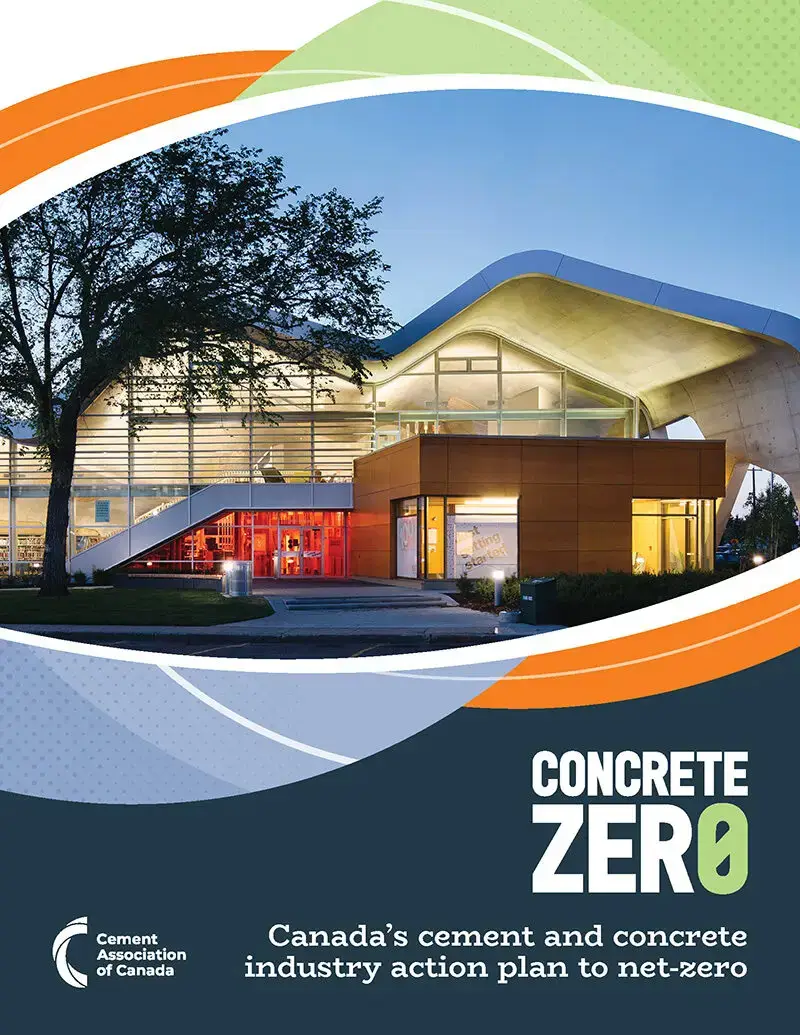
Canada’s Cement and Concrete Industry Action Plan to Net-Zero
Big industries can make a big impact
Concrete is one of the most highly consumed commodities globally, second only to water. The active ingredient of concrete is cement, the binding agent that holds it together. The cement sector is the world’s third-largest industrial energy consumer and the second-largest industrial CO2 emitter. It represents about 7% of CO2 emissions globally. Based on Canada’s National Inventory Report, cement manufacturing accounted for 9.7 Mt CO2 in 2020, the baseline year for this report. This represents about 1.4% of Canada’s emissions. Cutting our emissions will have a big impact.
Emissions Reductions in Net‑Zero 2050
CCUS
Concrete
Improvements
Cement
Improvements
Construction
Efficiencies
Clinker
Improvements
Carbon
Upstake
There is no silver bullet
There is no silver bullet, no one magic solution that will get us to zero. Rather, it will take many actions. In detailing our path forward, we have chosen a cautious approach; our Action Plan uses the carbon-reduction levers available today.
While our path to 2030 is clear, we need more research and development in clinker chemistries, carbon utilization technologies, materials innovation, and clean fuel sources like hydrogen to get us to net-zero by 2050.
David Redfern Chair of the Board (past), Cement Association of Canada
Adam Auer President and CEO, Cement Association of Canada
Together we can deliver #ConcreteZero
We are up for this challenge. Our Action Plan shows that emissions reductions (from our 2020 baseline) of 40% by 2030, 59% by 2040, and net-zero by 2050 are possible using today’s technologies. As new technologies are developed and proven, these reductions could accelerate. We will be transparent and accountable—and will release progress reports at least every 5 years. Our Action Plan is about finding true net-zero, so we do not account for offset purchases to get us to zero. Our report includes the aggregated scope 1, scope 2, and, where possible, scope 3 emissions towards the goal of achieving net-zero concrete by 2050.
Where economic and regulatory conditions stand in the way of our progress towards our emissions reduction goals, we will actively work to improve those conditions rather than use them as an excuse to delay action.
And finally, we will be a partner, working with governments across the country, members of the procurement, architecture, engineering and design community, and the construction sector to realize this goal.